Via 57 West
Architect: Bjarke Ingels Group (BIG)
Location: Manhattan, New York City
Year Completed: 2016
Client: The Durst Organization
Size: 830995 sq.ft.
Residential Units: 709 Units (34 floors)
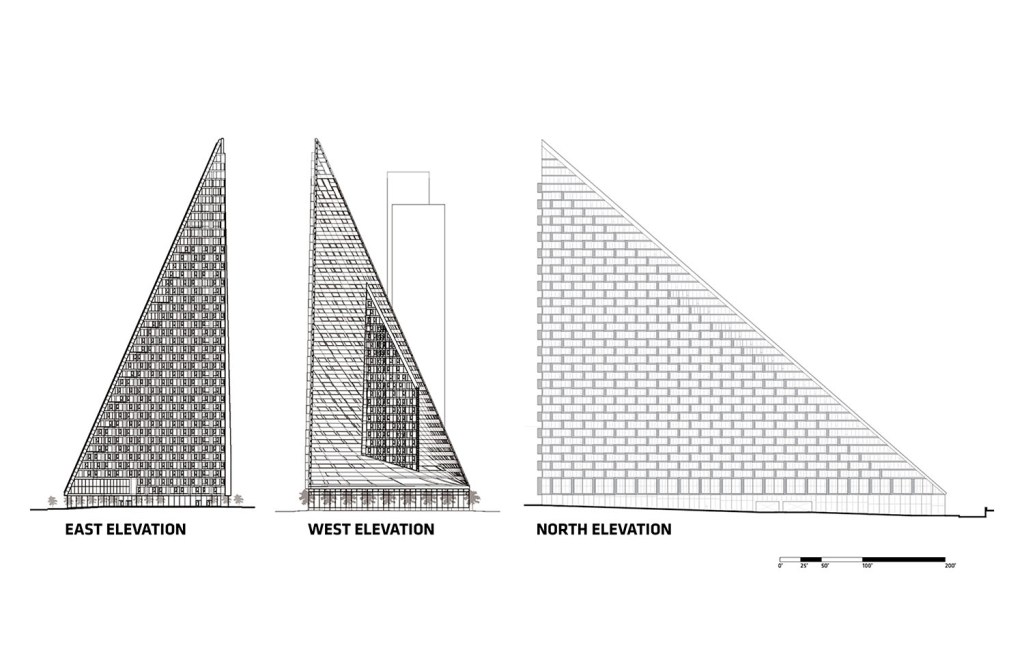
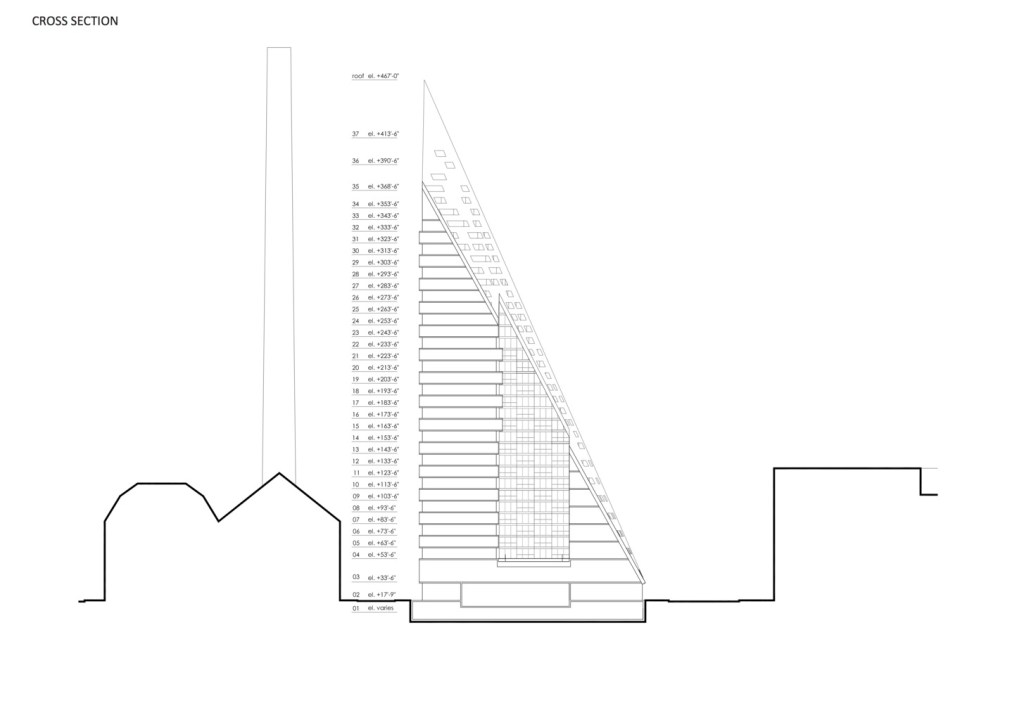
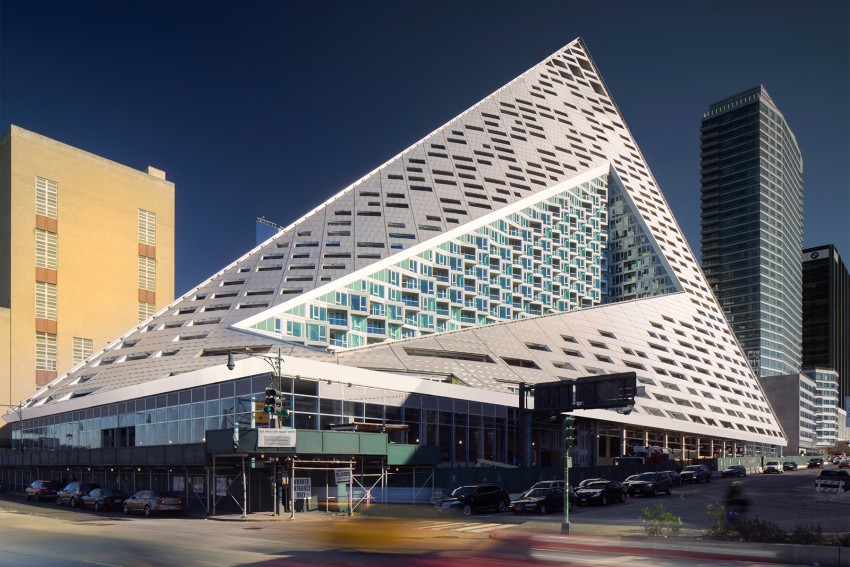
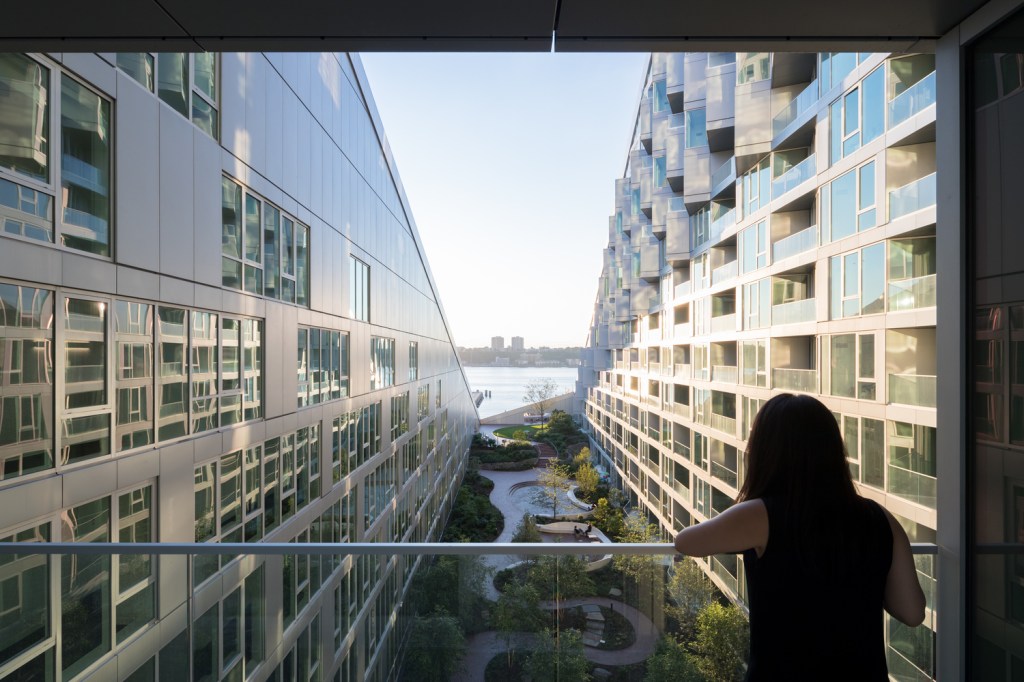
Description: VIA 57 West is the name of a residential building designed by the Danish architecture firm Bjarke Ingels Group (BIG). The pyramid shaped tower block or “tetrahedron” rises 467 ft (142 m) and 35 stories tall and is located on West 57th street in Hell’s Kitchen, Manhattan, New York City. West 57 is Ingels’s first New York project. While the views from Manhattan of the 709-unit building may resemble a distorted pyramid with a steeply sloped facade, rising 467 feet (142 m) toward the northeast, it becomes apparent that Bjarke Ingels had something else in mind as viewed from across the water in Weehawken, New Jersey. The most unrecognized feature created by the building’s sloped facade is the appearance it gives of an extra large sailing vessel making its way across the Hudson River With its angular balconies around an integrated green plaza, the block will connect with the waterfront and the Hudson River Park, taking full account of the surroundings while providing fine views with little traffic noise. The building has a floor area of 80,000 square meters, including residential and retail programming. The northern facade of the building features a number of balconies skewed at a 45-degree angle.
History: Bjarke Ingels is a Danish Architect, founder and creative partner of Bjarke Ingels Group. In Denmark, Ingels became well known after designing two housing complexes in Orestad: VM Houses and Mountain Dwellings. In 2006 he founded , Bjarke Ingels Group which grew to a staff of 400 by 2015, with noted projects including the 8 House housing complex, VIA 57 West in Manhattan, the Google North Bayshore headquarters. Since 2009, Ingels has won numerous Architectural Competitions. He moved to New York City in 2012, where in addition to the VIA 57 West, BIG won a design contest after Hurricane Sandy for improving Manhattan’s flood resistance, and are now designing the new Two World Trade Center building. Ingels and his company are the subject of the 2017 documentary BIG Time.
Bjarke Ingels met the New York developer Douglas Durst in the early 2000s when he was in Denmark. Durst, who visited Ingels’ Copenhagen studio in February 2010, found him very inventive, noting that unlike other architects, “What was striking about his work was that each design was so different, and designed for the locale.” The facade’s of the building like the North Facade where the balconies are skewed at a 45 degree angle is a pattern employed in previous works such as the VM Houses, in Copenhagen.
Drawings:



Photographs:






Diagrams:



Research and Analysis:
Sharing verbs:
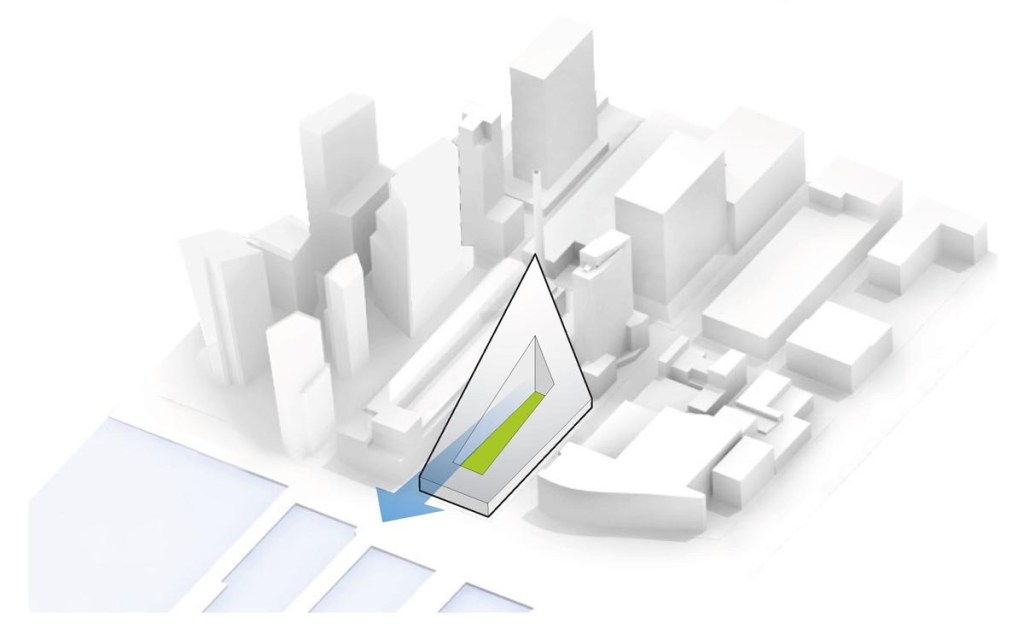
Merge- The triangular structure has been described as a merge between “European perimeter block” and ” Traditional Manhattan high rise”.
Gather- Creating a gathering space for the residents to socialize.
What we find Interesting: The most interesting part of Via 57 West is the Sail boat appearance created by the steep slope from the north east corner. The steep slope roofing creates a connection in scale between the lower structures of the building in the south and the higher floors in the north and west of the site. The bright grey metal cladding of the roof forms a perforated pattern, which is interrupted by openings that act as balconies facing the south. The building is very environmental friendly for example- It reduces the traffic noise and provides beautiful views of the Hudson River.
Private and personal space: People can view into the private residence spaces by standing in the courtyard because of the floor to ceiling glass windows allowing interior views.
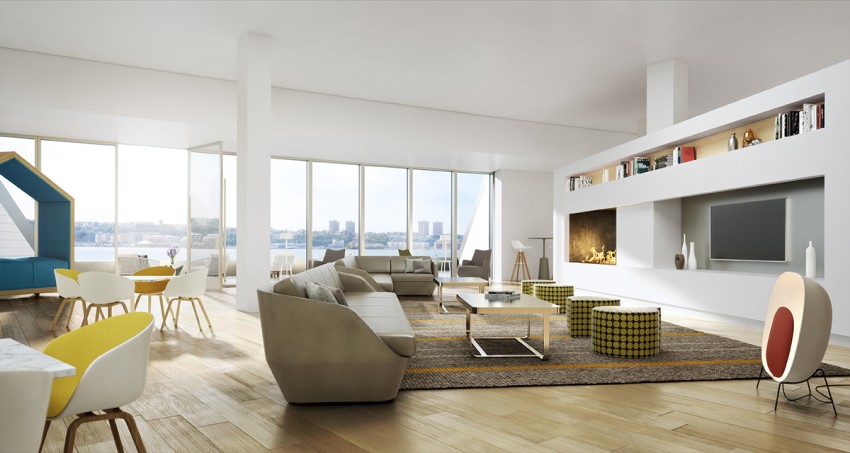
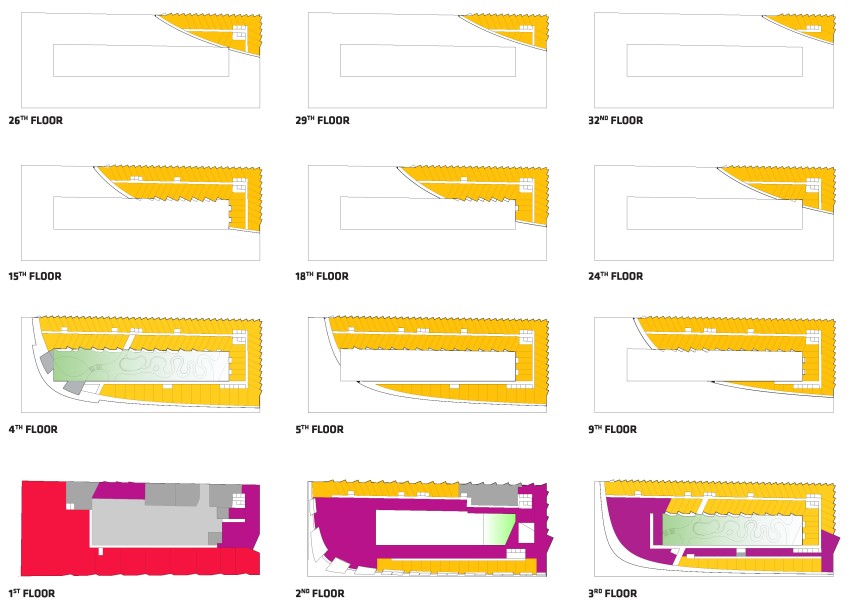
Program Arrangement: Its a combination of 45 degree angled units on the North East side where as, South West side has linear row of units. The north and east façades of the building feature a number of balconies skewed at a 45-degree angle, creating a fish-scale-like pattern, as does the south-facing wall on the north side of the courtyard. The sloping south and west exterior facade walls have a random pattern of recessed window openings of varying widths. Near the base, the steep slope of the upper parts of the facade taper out to a flatter slope. Apartments in the 831,000-square-foot building are arranged in a herringbone pattern to capture daylight and views, and the central courtyard, which is lined with amenities such as a children’s room and game room, offers ample green space. The Scandinavian-inspired interiors are simple, with white walls and oak floors; a staggered-brick wall in the lobby adds texture. The building runs 11 elevators for the people to reach different sides of the building. The units are connected by a lobby which runs in between and the units on either sides of the lobby. The building also consists of a eight screen theater (Landmark Theaters) on the ground floor.
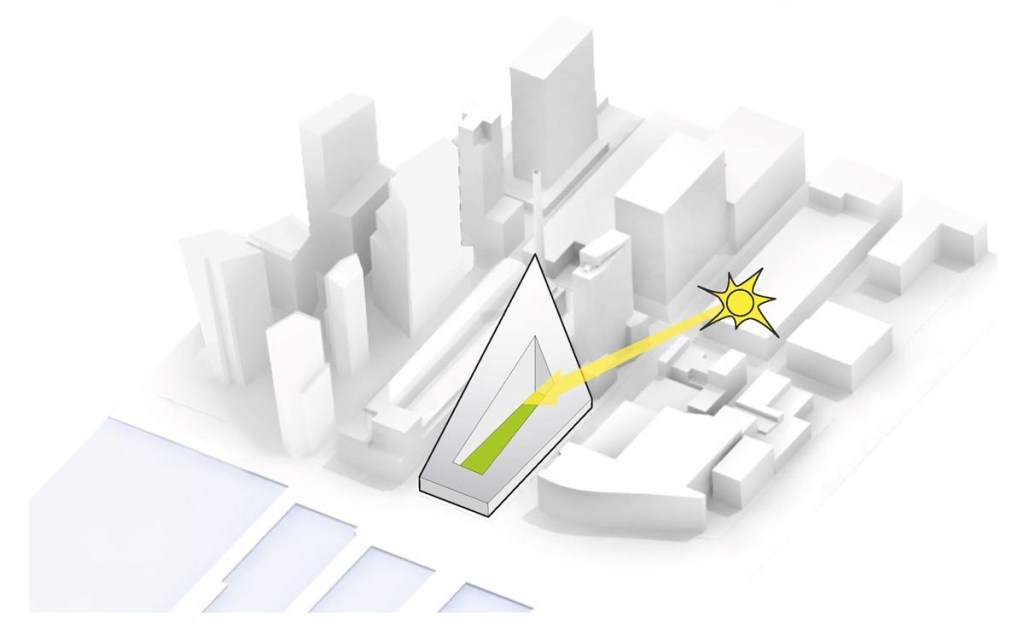
Impact of site and context: It is opposite to Hudson River. The 58th and 57th street provide maximum circulation around the building. The building is oriented in such a way that maximum units can view the sun rise and sunset. The 32 stories high residential block has a floor plan that reminds of compact and efficient historical courtyard buildings in Europe, but adds the lightness and wide views of an American skyscraper. The north-east corner arises to 142m high peak, which leads down towards the other three lower corners of the building. The structure’s courtyard thus opens up towards the Hudson river and guarantees as many views as possible. The constellation of various heights enables the sun to enter the block from the west and to provide enough sunlight for the river-facing apartments. The triangular structure reduces the noise of traffic for residence.
Structure and Materials: It is mainly consisted of Concrete and Floor to ceiling glass. There is a careful consideration of environmental impact through interior furnishings. The bright grey metal cladding of the roof forms a perforated pattern, which is interrupted by openings that act as balconies facing the south. The slope of the building allows for a transition in scale between the low-rise structures to the south and the high-rise residential towers to the north and east of the site.
Architectural Significance: It was Ingels’s first New York project. The buildings sloped facade gives an impression of a extra large sail boat. It was given the Emporis best skyscraper design award in 2016 followed by International High Rise Award (2016) and CTBUH Tall Buildings Award (2016). The pattern of the building was employed by previous works of the architect such as the VM Houses, Copenhagen.




 Hathaway Section - Spring 2020
Rishi & Shruti,
Similar to the Wozoco project by MVRDV I’d like to know a little but more about the project and it’s story. (See my comments to Trevor and Zoey on Wozoco: although not directed at your project they should give a fuller sense of ways to question why a certain story was chosen and to contextualize a project.) More specifically for your project, can you answer:
1. Who is Bjarke Ingels. What’s the history of his practice? What’s the role of this project in that?
2. BIG’s diagrams clearly show the combining and manipulating of two common Manhattan typologies: the courtyard and the tower: that’s clearly the main “story” for this project. Is there a reason you think this story was or is important to BIG, to the client, or to us?
3. Is sunlight and view the whole story? Where there any other factors that influenced the overall form of the project?
Focusing more on details on the building, for Wednesday I’d like you to address the following:
4. Can you speculate on why this combined hybrid is an improvement over one or the other of the tower and courtyard typologies if they had been used independently? (Thinking especially about sunlight and view to the units, but also about the central court.) I think we can intuit the shortcomings of the courtyard building, but what would have been “wrong” with a tower? Show me this graphically with diagrams.
5. You mentioned the sail-like appearance from a distance given the overall shape and the sloped surface of the “roof”. Many of the other precedent projects have adopted a more pixelated approach where units stagger and step back expressing the volume of the individual units, rather than containing them within a smooth overall surface?
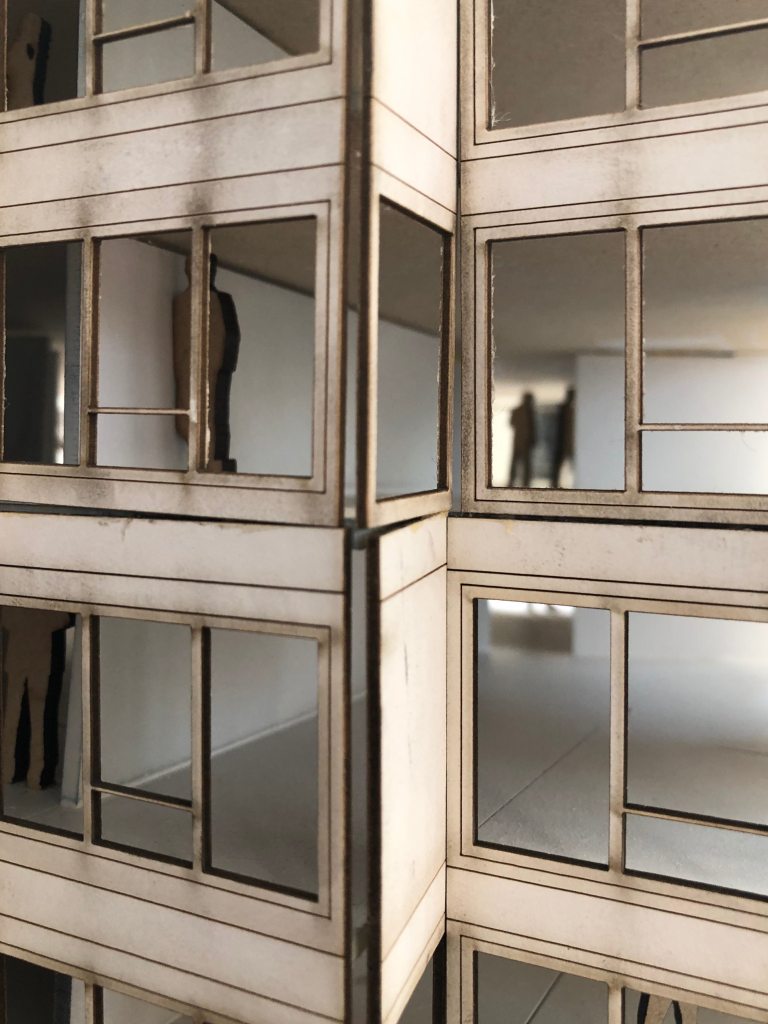
6. You mentioned the distinction between the 45-degree angled units and the orthogonal units. Looking closely at the plans and photographs, is there a specific logic for where one type of unit occurs and where the other occurs (diagram on plan/section)? In terms of being in the unit, is there a difference between the two types of units in terms of space? view? privacy? sunlight? other?
I’m also interested in more of the unexplained details of the project: looking at the color-coded plans can you identify the specific programs corresponding to each color and similarly color code a section. I’m also hoping that there are drawings at a larger scale that show the non-residential spaces at the base of the building and the nature of a unit or a grouping of units in plan and section. (For this you may need to find the associated architect or “architect of record” for the project as they may have been responsible for the actual unit design. With this additional documentation, will you show graphically in diagram form:
7. Circulation and entry: are there multiple entrances/lobbies throughout the building. How do residents arrive? get to their units? get to the courtyard space? Are their other semi-public spaces for the residents?
8. Privacy: Can you diagram this over the section? At a scale that shows the impact of unit height above the courtyard? View from other units vs. from the courtyard…
9. “Sharing” verbs: looking back to your responses to the preceding questions (particularly #6 and #7) are there verbs that describe either formally how the units are assembled into a building or how programmatic sharing occurs within the building?
10. This might be a dead end, but I’ve never understood exactly how the units that abut the sloping roof work: do you understand them, are they different at the lower levels vs. what must clearly be the penthouses at the NE corner?
LikeLike