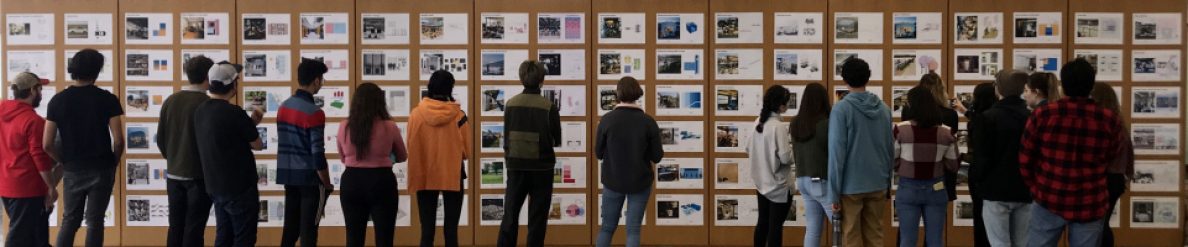
Main Story of the neighborhood: The main story of the neighborhood that we were trying to present is that Hyde Park is a unique neighborhood on the South Side. In our zoomed out diagrams and maps, we mostly compared other surrounding neighborhoods to Hyde Park to show the contrasts. I was responsible for both a … Continue reading Phase 4: Individual Post
Tag: spring 2020
Phase 5.1
Populations I am thinking about an apartment building that is affordable but also provides a high-quality living style, maybe the size of the individual apartments won't be very big, and the FAR would be pretty high. Right now, there are tons of apartments to rent in Hyde Park, and the price for a one or … Continue reading Phase 5.1
Phase 5.1: Proposal
Target audience- Residents: 1-Single, Couple 2- Students (can live 3 per apartment) 3- working people in Uptown. Outside people: College students, Working people. Age of people ranging from 16-50. Public facilities: Theater OR Auditorium Gym, Swimming Pool Conference RoomsWorking rooms (students, Nearby Office staff, Building residents) Maybe a game room? Examples Phase:1- The Space provides … Continue reading Phase 5.1: Proposal
Phase 5.1: Proposal
Populations and Programs For most of my life I've been a rock climber, so when the idea of rock climbing as a shared program on the blog really stood out to me as something I might be interested in exploring architecturally. With the knowledge that Uptown is a gentrifying community and the fact that there … Continue reading Phase 5.1: Proposal
PHASE 5.1: WEDNESDAY DESK CRIT
MIXED USE DEVELOPMENTS INTEGRATING THREE OR MORE USES INTO INE STRUCTURECREATING A GREATER HOUSING VARIETY & DENSITYASPECTS OF ENERY SUFFICIENCY & SUSTAINABILITYFORMING A STRONG NEIGBERHOOD CHARACTERINTEGRATION OF CITY SERVICES & CONNECTIVITY TO PUBLIC TRANSPORTFLEXIBILTY TO ADAPT TO CHANGE VERTICAL APPROACH: SINGLE-MULTY STORY BUILDING HORIZONTAL APPROACH: FORMED AROUND AND OPEN SPACE (COURTYARD), SPREAD ACROOS A PLANE … Continue reading PHASE 5.1: WEDNESDAY DESK CRIT
Phase 5.1-Proposal
Conclusions based on research, maps and diagrams form Phase 4 Target Audience: Residents: young single/living alone (max couple) college students from the University of Chicago people working in the area Communal/commercial activities: aged approximately 18/20-35/40 for the college students and people working around the area or teens (15/20) to 25/30 for the school students as … Continue reading Phase 5.1-Proposal
Phase 5.1
Populations and Programs I would like my project to serve low income families to create affordable housing in this area. We found in our research that the surrounding neighborhoods around Hyde Park are generally of a lower income and have higher unemployment rates. This housing would give the lower income families an opportunity to live … Continue reading Phase 5.1
Phase 1: Documentation
EXAMPLES FROM MY DAILY LIFE: The three diagrams created for the picture are representations of different typs of shared space that I encounter on a daily basis. The analysis of these spaces shows how people exit, enter, move through and make use one space. EXAMPLES FROM ELSEWHERE: The images and diagrams show spaces that were … Continue reading Phase 1: Documentation
Phase 3: Michael Ocejo
Merge: The model is divided into five different color groups that combine as they go into the center. The desinty also increases as user goes into the center of the model. The candles are also placed on an angle to add a sense of percarousisness. I wanted to create a feeling of hierarchy in the … Continue reading Phase 3: Michael Ocejo
Phase 3: Derek Pietrowski
Q-tip For my first design I chose q-tips as my found object. I explored many different concepts for developing this as a space that shelters and condenses a space as you move deeper into the structure. My final concept explored this idea of condensing the space and creating different levels of shelter as you move … Continue reading Phase 3: Derek Pietrowski
 Hathaway Section - Spring 2020