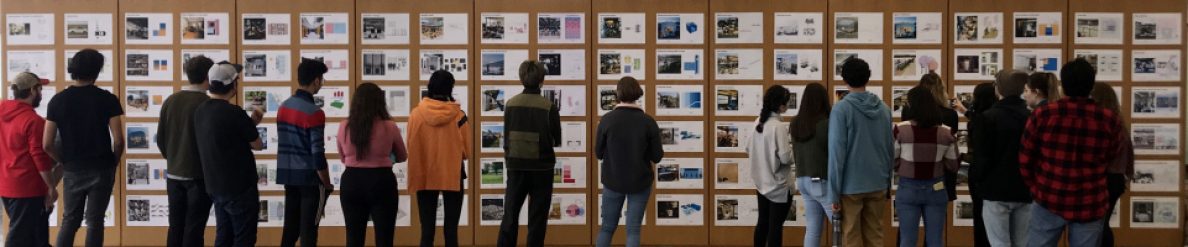
In my collage, I was trying to reflect what I felt in my block. In my block, I felt a contract between the dynamic feeling of the construction process that is running in the block and the Home that are static and more stable. In my collage, I tried to reflect this feeling by creating … Continue reading Phase 3,Phase 4
Phase 04: MALHAR KATE
Unit Massing Aggregation 1 Aggregation 2 Aggregation 3 Drawings I wanted to continue the idea of the gradation from the collage and the collage model. I did this with a banding that connects the different programs of the units with volumeteric elements that transition into planar elements. The bands signify the openings. The program is … Continue reading Phase 04: MALHAR KATE
Phase 4: Damla Sucuka
I started my review by describing the relationship between my 3D collage model and my module design. The space that formed between two buildings and how it created a private but an open space inspired me to focus on the community of people suffering from social anxiety. The panel of reviewers seemed to like this … Continue reading Phase 4: Damla Sucuka
Phase 4: Trae Horne
Midterm Immediate context is important in diagrams.Claim all of the site that is given, similar to the three dimensional collage model. Also the spaces in between the units in the aggregations should become more open and porous.Character of the spaces in between need to be explored.Cluster variations: Clusters may be different to help site become … Continue reading Phase 4: Trae Horne
PHASE 3: MALHAR KATE
Collage With my intersection, Emerald Avenue and 33rd Street, I wanted to show the separation from one side of the street to the other side. My first experience of the site was the a complete separation from the residential to the industrial commercial side of the street. I showed this through using windows from the … Continue reading PHASE 3: MALHAR KATE
Phase 3: Trae Horne
2D & 3D Collage The collage that I worked on was based on the edges and connections that I saw on the street. I focused on the places where material met material; concrete meeting concrete, brick bordering concrete, grass touching wood, etc. The distinction between the edges is blurred through the focus of the collage. … Continue reading Phase 3: Trae Horne
Phase 3 : Geliang Zhu
My site was located on Lowe Avenue between 32nd and 33rd street. What attracts me here is the elements that make up the street in different layers, and the windows of various shapes. In my collage, I focused on the windows of the cars and the houses. I cut off the superfluous objects of the … Continue reading Phase 3 : Geliang Zhu
Phase 4: Chengyun Wu
Since my model is focused on window, I pay more attention on the sunlight. During the presentation one of the Professors gave me a really useful suggestion for my aggregation. He said that I could arrange the unit base on how each unit can get sunlight without other unit’s effect. Instead of thinking of community … Continue reading Phase 4: Chengyun Wu
Phase 3: Chengyun Wu
My site located in an intersection between 32nd Street and S union Ave. The surrounding buildings are not tall, its only 2 balconies and mostly are within a flat roof. I found out that the windows are really unique and beautiful over there, that’s why I mostly focused on the window. When I first went … Continue reading Phase 3: Chengyun Wu
Phase 04: Cecilia Charney
The panel of reviewers responded well to my project, and gave me feedback in the context of moving forward with the project. They seemed to think my form was successful, but they recommended that I think about privacy and how the units will feel private and unique in the aggregation, because the unit I presented … Continue reading Phase 04: Cecilia Charney
 Hathaway Section - Spring 2020