

Mass Timber & General Guidelines
As a studio we’re using mass timber framing for our structure. For our section that means primarily CLT (cross-laminated timber) panels for floors and structural walls and glulam (glue-laminated timber) columns and beams. All non-structural walls (and some structural walls) can be built out of typical stud wall construction. The basement is different, see below.
A “view” of your digital framing model is a required drawing. The assumption is that you’ll model the entire building and then create a 3D view or series of views to show the overall structure. See the end of this post for examples and suggestions of how to show a structural model.
Below are a a few rules (many are rules of thumb) to help you get structure into your drawings and working with your projects.
GENERAL
- Laminated structural wood elements cannot be used in wet environments. This means your basement structure should be concrete: walls, floors, and columns. If your ground floor level is at grade then this should also be concrete. If the ground floor is raised above grade by more than a foot or so you can use CLT, although with a concrete structure at the basement below it may be simpler to just make this floor concrete.
- This also means that at exterior walls the wood structure can be visible but only BEHIND glazing: the glazing system runs continuously to the exterior side of the columns and beams. At balconies or overhanging roofs the structural elements can be visible on the underside (this is considered “dry”) as long as the top and sides are covered by another material like a roof membrane or exterior cladding.
- It is possible to bend the above rules. For example if you wanted to extend a beam or column to the exterior of your building you could propose to clad it, shift to a wood member suitable for exterior use, or use another material.
FLOORS
- CLT panels are built up of nominal 1 1/2″ thick layers of boards called lamellas. Each alternating layer runs the opposite direction as the adjacent layer and panels have an odd number of layers so that the top and bottom layers always run in the long direction of the panel (thus making it stronger in that direction). Typical panel thicknesses are 4 1/8″, 6 7/8″, 9 5/8″, and 12 3/8″, corresponding to 3, 5, 7, and 9 uniform layers. As a starting point you can assume you’ll be using a 7-layer 9 5/8″ panel.
- In most cases the panels are topped with 2″ of concrete or other floor topping material (to help with vibration and acoustics) and a finish floor material. If you include this and expose the panel below your floor thickness will be approximately 12″.
- The typical maximum panel size is 8′ wide x 40′ long, but some facilities can produce widths up to 10′ and lengths up to 60′.
- Panels typically are joined together at the edges (think of an oversize tongue and groove joint) to create a continuous floor slab. Because of this and the panels ability to span in both directions they can be supported only at their corners, although it is more common to have a continuous support at least along the short edge. (See example layout drawings below).
- Roofs are built the same as floors, the only difference is the added layers on top of the CLT to create a low-slope roof assembly, green roof assembly, or…
BEAMS
- Glulam beams come in a variety of depths, again based on layers nominally 1 1/2″ thick. The main difference from CLT is that the members are long and thin and the laminations all run in the same direction. (Think of a bundle of 2×8’s all stacked on top of one another.) There are standard widths based on wood stud framing and depths based on the laminations, but we’ll need larger members and are going to size approximately.
- For a simple-span glulam beam running between two supports and taking a uniform load (dead load and live load) from the floor above, a good rule of thumb is to set the depth of the beam in inches equal to the span of the beam in feet. EXAMPLE: for a beam running between two columns 24′ feet apart, set the depth of the beam to be 24″. Note that this is a gross simplification as the tributary area (how much) of the floor and the width of the beam and many other factors affect this, but in typical situations it works pretty well.
- In our lecture 40′ was noted as about the maximum span for a glulam beam. At longer spans the above rule begins to break down and the beams need to get even deeper. So it is common to switch to a long-span member (like a truss) for spans over 40′, but it is possible to have a deep glulam if it works in your space.
- A rule of thumb for beam widths is that the width of the beam should not exceed half the depth of the beam: ie the 24″ deep beam above should be 12″ wide or less. But, for our purposes, unless you have unusual configurations we’ll set the width of the beam to match the width of the supporting columns, as much for aesthetics as for structural reasons (structurally you could often get away with a thinner beam).
COLUMNS
- The number one rule of columns is they need to stack on top of one another- from the bottom of the floor all the way up to the top. If you think about it, a column is concentrating the entire load of a portion of a floor and transferring it down to the next level where that column picks it up and adds to it the load from its own floor, and so on. This puts a lot of loads on the columns as you get to the bottom floors where you can end up with some pretty big columns. But if you get to a floor below and there is no column (or structural wall) to pick up that load it would have to be transferred to the nearest supports by a beam that is now carrying the load of several floors above coming down on it concentrated entirely in one point. This is difficult to do in steel and concrete, and almost impossible in wood.
- Column sizing factors in the height of the column, the cumulative load of the floors above, and other aspects of the structural layout. But, for our purposes we’re going to assume that the range of appropriate column sizes for your buildings will be around 8″ x 8″ (supporting only one floor, or a small support at a stair…) up to 18″ x 18″ (at the ground floor, supporting several floors above). Totally fine for aesthetic reasons to pick one column size at the higher end of the range and keep it consistent throughout the building.
- EXCEPT, if you have very tall columns not regularly braced by floor slabs (ie at a multistory space or supporting a tall facade wall) the columns might need to be deeper (at least in one direction). Talk to me about these conditions.
WALLS
- We’re not really worrying about the lateral (sideways-acting) loads, but in your structural framing models you should show that your enclosed egress stair and elevator shaft walls are made of CLT as shear walls to address this. In plan these can still be drawn as regular walls as a 6 7/8″ CLT panel can function as a shear wall and support some floor load.
- Your non-structural walls can enclose a portion of any column they run next to or as a design decision you can choose to have the walls pass by adjacent to the column without touching it. Just be consistent and use the same approach at all similar situations.
- At facades with multi-story glazing , the plane of the glazing and any areas of solid exterior wall usually pass by outside of the wood structure so that it is fully inside the glazing system.
- STRUCTURAL WALLS. For some of your projects it will make sense for the exterior walls (or some specific walls) to be CLT panels to handle unusual geometry. This means beams and floor panels can be supported directly by the CLT wall. How thick this wall would need to be depends on the configuration and what it is supporting so please review with me.
EXAMPLE DRAWINGS
Below are the first examples from the structural precedents list in our google drive. There are more in that doc you can look up. Note that many of these use simple animations (a series of images) to show the different components. I can’t stress enough how successful this is in a digital presentation but you can also find a vantage point where a still image shows enough of your structure to give us the point (like the section perspective in the second example below) or use more traditional drawing techniques like an exploded axonometric to show more of your structure.
The example below is a GIF showing the actual sequence of construction including more than structure. You could make a simpler version of this as a GIF or just a series of images that you click through manually to show the different levels of your building. Also, a couple things to note about the structure:
- The first walls are the CLT walls (similar to yours) around the elevator and stair shafts: they are made of vertical panels and are continuous to the top of the building spanning multiple stories.
- The ground floor has a modest-sized open space with columns at the facade and beams spanning back to interior walls. The rest of the building is built using CLT the main walls repeat on each floor as bearing walls.

https://generatetechnologies.com/work-model-c
The images in the slideshow below are certainly more detailed than yours will be, but as an idea of zooming in to show more detail you could use them as a precedent. Showing a couple stories of a bay of your building in 3D is similar to the optional drawing of showing the same area in a wall section and as an elevation, but I’d also accept as your “framing model”.


http://mg-architecture.ca/work/wood-innovation-design-centre/
Another GIF animation below. Again a great technique whether compiled into a GIF or just a series of images that can be run in series. This one shows prefab housing units and the layering of the facade with some mass timber walls and some built as conventional stud walls over the timber frame (the side walls with no glazing).
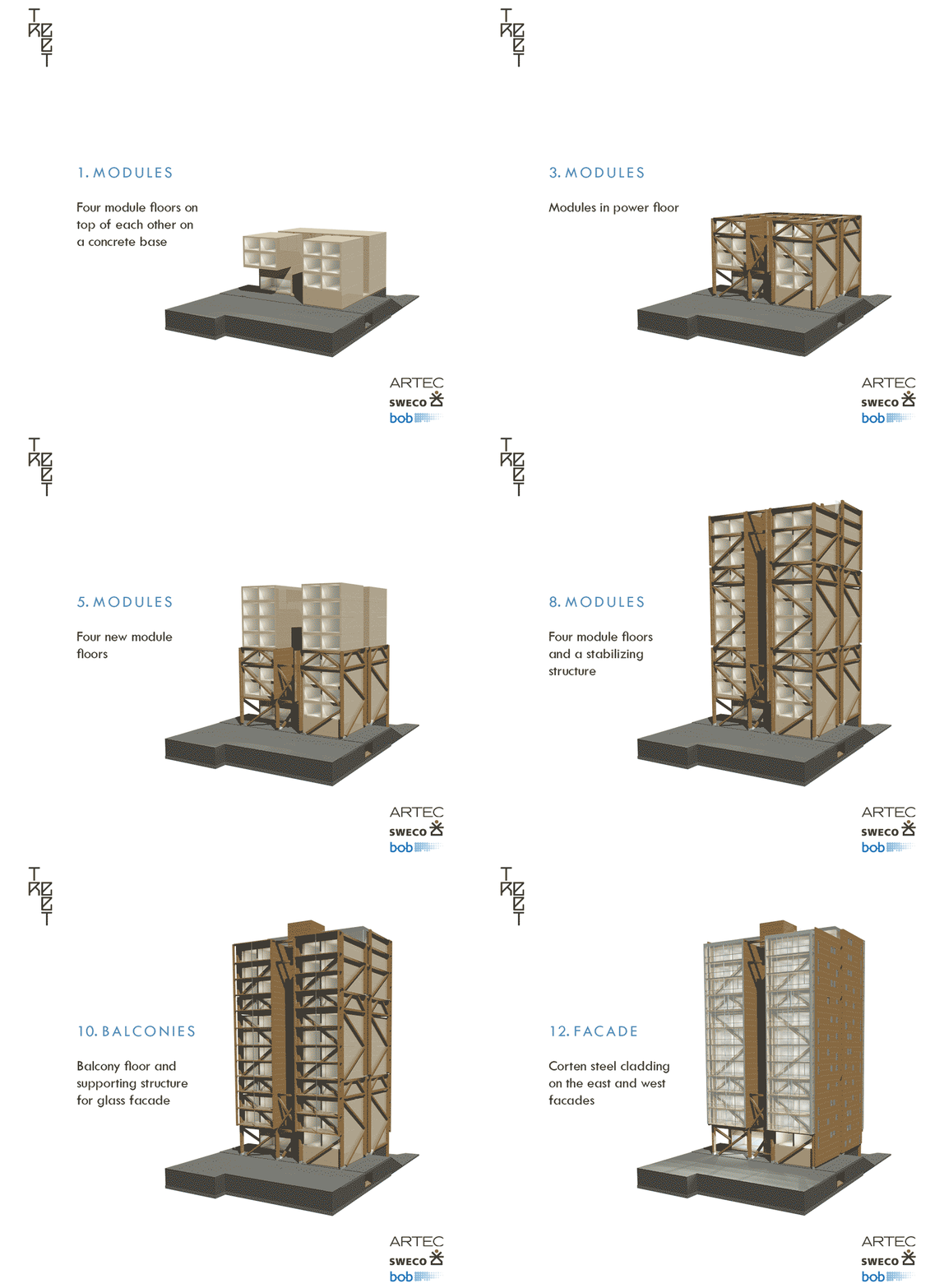
 Hathaway Section - Spring 2020