
PARKING SPACES
Graphic Standards has a section on parking design, but the Chicago Zoning Code (which would actually govern your parking spaces) is easier to understand. See excerpt below:
17-10-1000 Parking area design.
The parking area design standards of this section apply to all off-street parking areas.
17-10-1001 Dimensions. Unless otherwise expressly stated, off-street parking areas must comply with the following standards:
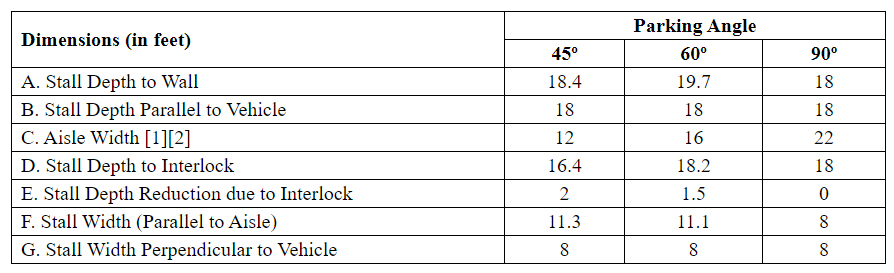
Note: For bumper overhang deduct 2 feet from stall-depth-to-wall dimension and 4 feet from wall-to-wall dimensions.
[1] Aisle width standards for parking angles of 90º may be reduced to 20 feet when parking stall width is increased to 8.5 feet.
[2] Aisle width standards for indoor accessory parking garages in existing buildings that are being rehabbed for residential use may be reduced to 16 feet for parking angles of 90º.
Figure 17-10-1001

…
17-10-0900 Accessible parking (for people with disabilities).
17-10-0903 Layout and Design.
17-10-0903-A Vehicle Spaces. Car and van parking spaces must be at least 11 feet in width, except that car and van parking spaces serving residential buildings with 19 or fewer Type B units may be 8 feet in width.
17-10-0903-B Access Aisle. Access aisles serving accessible parking spaces must comply with the following standards:
1. Width. Access aisles must be at least 5 feet in width. Access aisles serving diagonal parking spaces must be located at the passenger side of the parking space served, based on the vehicle moving forward into the space.
2. Length. Access aisles must extend the full length of the accessible parking spaces they serve.
3. Marking. Access aisles must be marked to prohibit parking in them.
Professor’s note: Remember one of your parking spaces must be accessible. If you’re not familiar with the terms above or where the access aisle goes you can google an explanation or look it up in Graphic Standards, Ching…
PARKING RAMP DESIGN
There are different guidelines out there for how steep you can make an access ramp, but to not have too much of an impact on your ground floor plans, for this section we’ll be using the requirements below:

OTHER CONSIDERATIONS
Loading Zone. A dedicated loading zone is not required by the assignment, and for many of you wouldn’t be required by code. (The requirement is based on uses and their sizes in the building). However, if you have space at the rear of your building making a space for a small moving, delivery, or service truck to park without blocking access to your garage entry or that of your neighbors is worth considering. These spaces are typically 10’w x 25’l.
Parking Stall dimensions. The code allows 8′ wide dimensions, which is what most developer’s use (more cars = more money). But if you have ample space you may want to consider 8′-6″ which allows you to adjust some of your other dimensions, or even 9′-0″ which give you more room to open your door if your neighbor has a big car or isn’t parked well.
Structure. You also will need to make some provisions for columns when we add in structure, so again wise to leave yourself some flexibility.
Number of parking spaces. 6 is the minimum, but obviously that’s pretty skimpy so you can choose to provide additional spaces, particularly if you have empty space in your lower level.
One-way vs. Two-way Ramp. Obviously in a real garage you would have separate entry and exit or at least room for cars going the opposite way to pass one another. However, if you only have a small number of spaces the odds of needing to pass another car on the ramp are low enough you could definitely have a one-way ramp.
90 degree vs angled parking. In garages with a one-way loop, angled parking can work well, but I doubt you have enough space for that; angled parking may make it very hard for your residents to turn around and get out of the garage.
 Hathaway Section - Spring 2020