ARCHITECT: MICHEAL MALTZAN
LOCATION: LOS ANGELES, CALIFORNIA,
6TH STR. AND MAPLE AVE.
TYPE: MIXED-USE, AFFORDABLE HOUSING
SIZE: 95,000 SF; 6-STORIES
STATUS: COMPLETED IN 2014
LEED STATUS: LEED FOR HOMES PLATINUM
COST: $40 MILLION
INTRODUCTION
Exploring the possibilities of shared space by pushing the boundaries of privacy.
THE ARCHITECT
MICHAEL MALTZAN
Michael Maltzan was born in 1959 in suburban Long Island, as one of four children. His father worked as a medical supply’s man, while his mom state at home. After Hight School Maltzan got two Bachelor degrees from Rhode Island, the first one in fine arts, the second one in architecture and a Master degree in architecture at Harvard. Shortly after graduating he married his wife and together they moved from Boston to Los Angeles. They were flat brook when they arrived at their new destiny and Maltzan was eager to find a job as soon as possible. He eventually got hired by his later mentor Frank Gehry to work on the 1987 competition entry for the Walt Disney Concert Hall. After working with the firm for a while he decided it was time to develop his on carrier, when landing his first mayor residential commission through Alan Hergott. He a top layer at the time, offered Maltzan $2 Million Dollars to develop the new project.
In 1995, he found his firm Michael Maltzan Architecture Inc. (MMA). Since than he won several awards such as five progressive architecture awards and in 2007 he became a fellow of the American Institute of Architecture. Besides his work at the firm, he holds lectures and critics at Universities and convention all over the World.

MMA
MMA is an architecture and urban design firm placed in LA, developing projects for communities. The firm is committed to finding progressive and transformative architectural solutions. Their philosophy is to shape the world we experience through the build environment surrounding us. They are focused on working on exploring the possibilities and complexity of architecture as tool to transform society. MMA is engaged in the urban design, design and construction process of projects and often working together with other organizations to realize larger projects. The firm holds partnerships with organizations and other companies to increase design possibilities.
HIS WORK
Maltzan’s work is influential and visionary. He is trying to establish an environment that helps those people that feel left out, to reconnect with their own opportunities and the community that they are surrounded by. His work indicates the importance of daily interactions and involvement with the community. He is trying to create a more dynamic city through mixed-use abstract architectural forms.
Within the last seven years he designed three new buildings in the Skid Row Neighborhood and with every project he explored possibilities to increase the success of the development. He is challenging himself by taking on projects that require design to be applied to a social problem. Because he knows about the importance of a permanent home, as starting point for leaving a vicious circle. While exploring new types of mixed-use arrangements, he also pays attention to exploring new shapes within unusual structures. In his design approach he is focused on creating accessible private and semi-private indoor and outdoor space using quality materials and sustainable innovative building methods.
With these new projects he is also reacting to the fact that capacities of the city are reached and a need to build with greater density. Providing a greater building density allows for more space for the individual which in turn supports the idea of integrating the residences needs into the architecture. With these mixed-use projects he is able to put together a community. Although, it isn’t a community by choice but convenience it is providing a sustainable support system for its members.
Through including certain characteristics in to his design approach he is able to balance efficiency, durability, practicality and a unique design.
Because he is making the people and their need part of the solution he had great success with his ptojects.
OTHER MMA HOUSING PROJECTS
RAINBOW APARTMENTS (2006)
- 88 transitional housing units on six- floors
- Central courtyard, community programs
- The design is intended to reduce individual isolation
- Feeling of security and safety through the openness of the space

NEW CARVER APARTMENTS (2009)
- Part of the Skid Row Housing Trust
- 97 housing units for formerly homeless people and disables residence
- Community space, natural lighting, open circulation paths, central courtyard

CREST APPARTMENTS (2016)
- Very recent development for the Skid Row Housing Trust
- Transformation of an open site of suburban LA into a 64 unit apartment complex for former homeless people
- Connectivity to public transportation and local resources
- Access to social services
- Experience of self-efficiency through apartment living and common areas
- Sheltered courtyard, open terrace and corridors, natural lighting, cross ventilation
- Individual studios are located on the upper floors, hovering over the ground level
- Framed views towards the city and corridors

THE SKID ROW NEIGHBERHOOD
The name derives from the wooden tracks that were once used to haul heavy lumber to the timber yards. Therefore, the area still is defined by the darker aspects of transient immigrant life. Its origins lie in the industrial development of the agriculture sector LA’s.
The 50-block section located in downtown LA is bounded by the historic core and “Little Tokyo”, overlaying parts of the downtown industrial district. Since the beginning the neighborhood was home to short term workers and rail crews.
By 1930 many of the houses were converted into cheap hotels. After the Vietnam war many of the traumatized soldiers moved to the area as well as alcoholics and really anyone who was pushed aside by society. Until today the neighborhood has one of the highest concentrations of homeless people in the USA.
In order to find a solution to the many problems the area was facing, the Skid Row Housing Trust was set up in the late 1980s to provide permanent affordable housing to the people. The goal for this new project was to provide a perspective to the most vulnerable members of society.
LOCATION


AFFORDABLE HOUSING
Every member of society should have a decent place to live. If individual don’t have a stable living environment chances are that they are finding themselves struggling with every other aspect of life too. LA is one of the least affordable cities worldwide which certainly is leading to more homelessness.
THE SKID ROW HOUSING TRUST ORGANISATION
The organization provides permanent supportive housing for people who lived in poverty or were homeless. The intentions are to create an environment that helps developing new opportunities for anyone who is struggling with finding a home. The idea is to work with a concept that combines private living spaces with communal facilities and social services.
STAR APARTMENTS (2014)
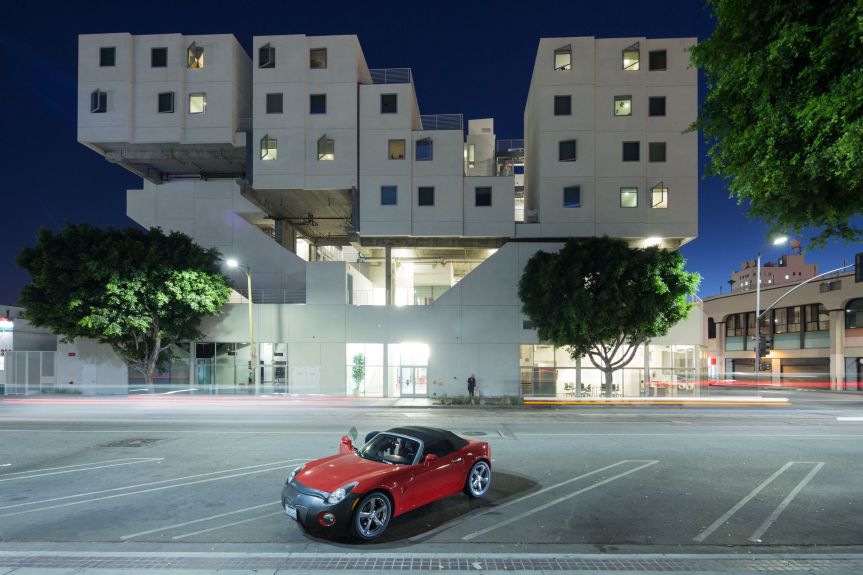
Star Apartments is a building project, that is focused on the integration of an affordable social housing project into the city fabric of LA. The building development was completed in 2014 by Michael Maltzan’s Architecture in cooperation with the Skid Row Housing organization. The idea is to not only provide housing to formerly homeless people, but to develop a project that would allow its residence to reconnect with an independent life and society. In order to integrate the new building structure into the urban environment, they choose to add on to an existing structure. A former one-story commercial building was transformed into the base of the new structure.
THREE–ZONES
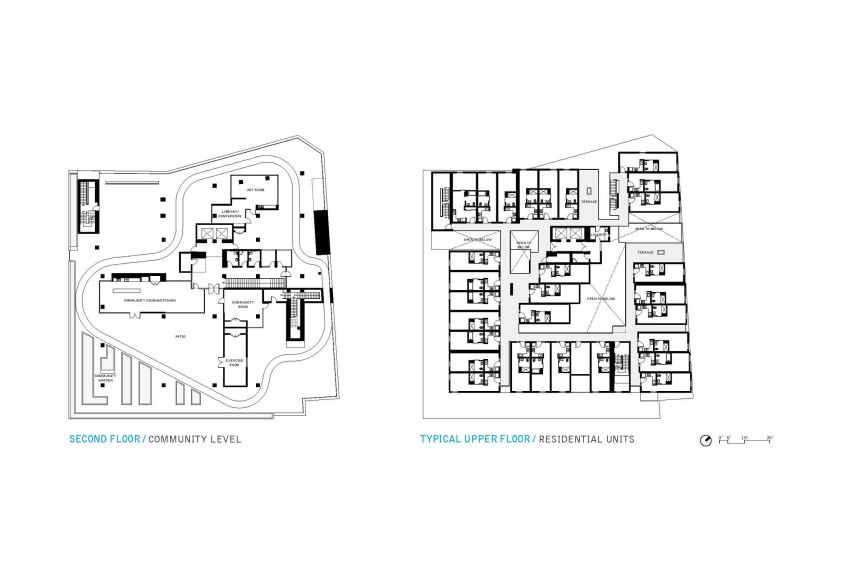
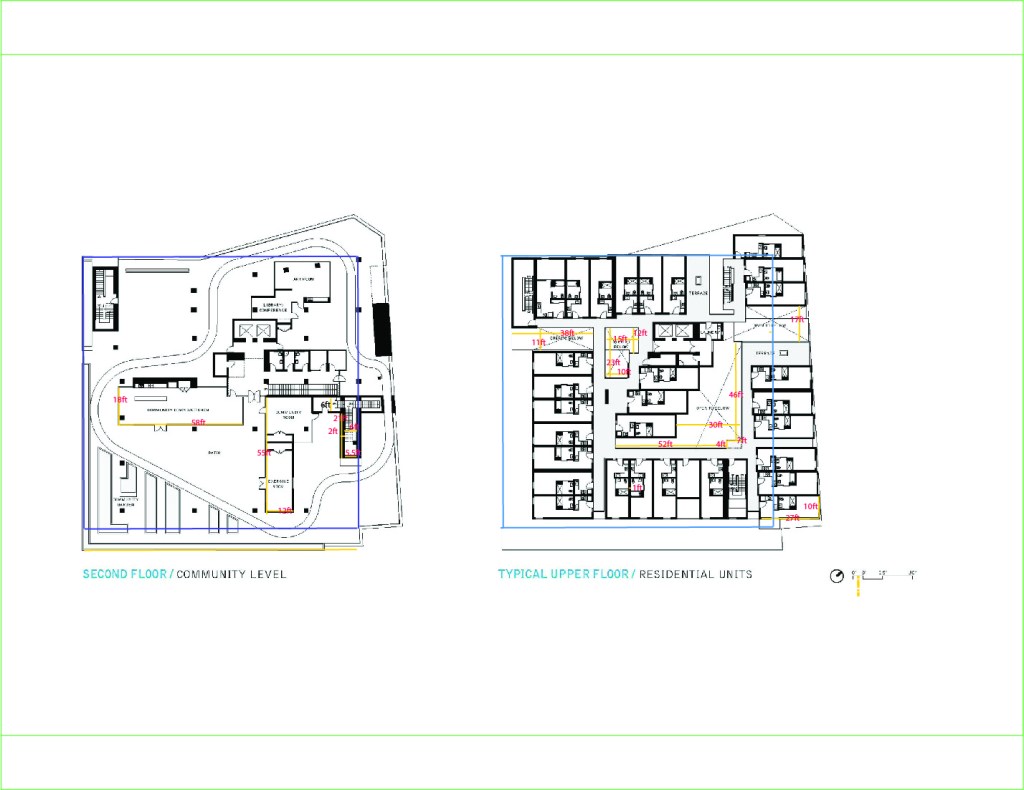
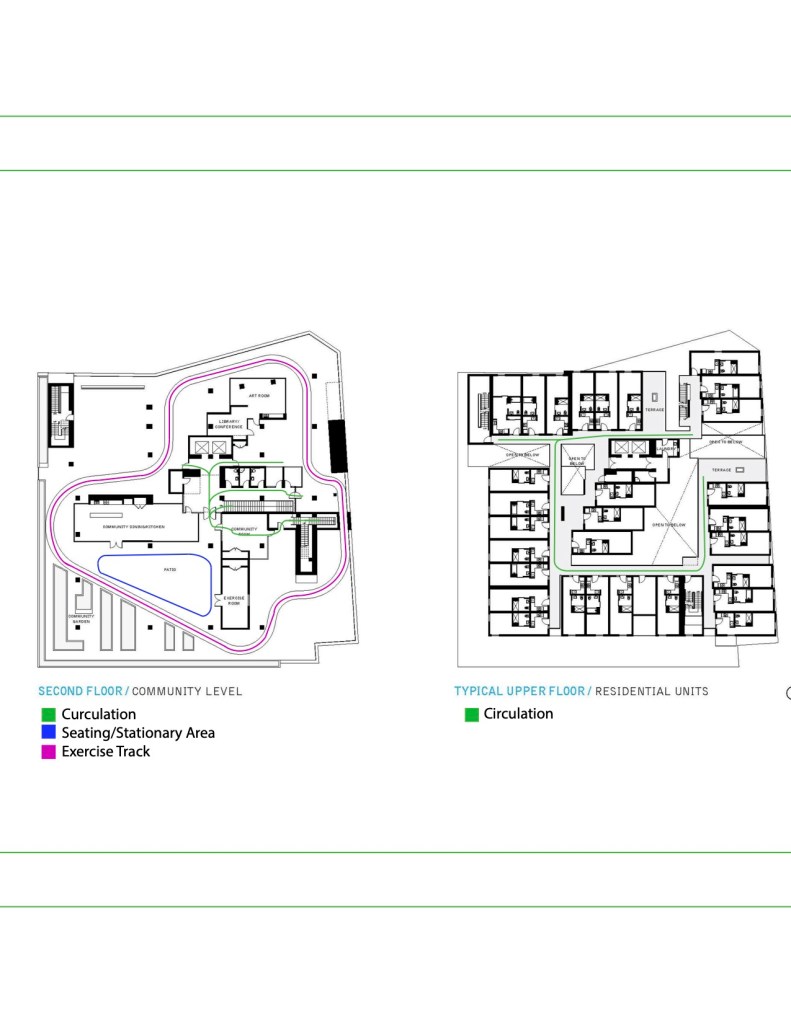
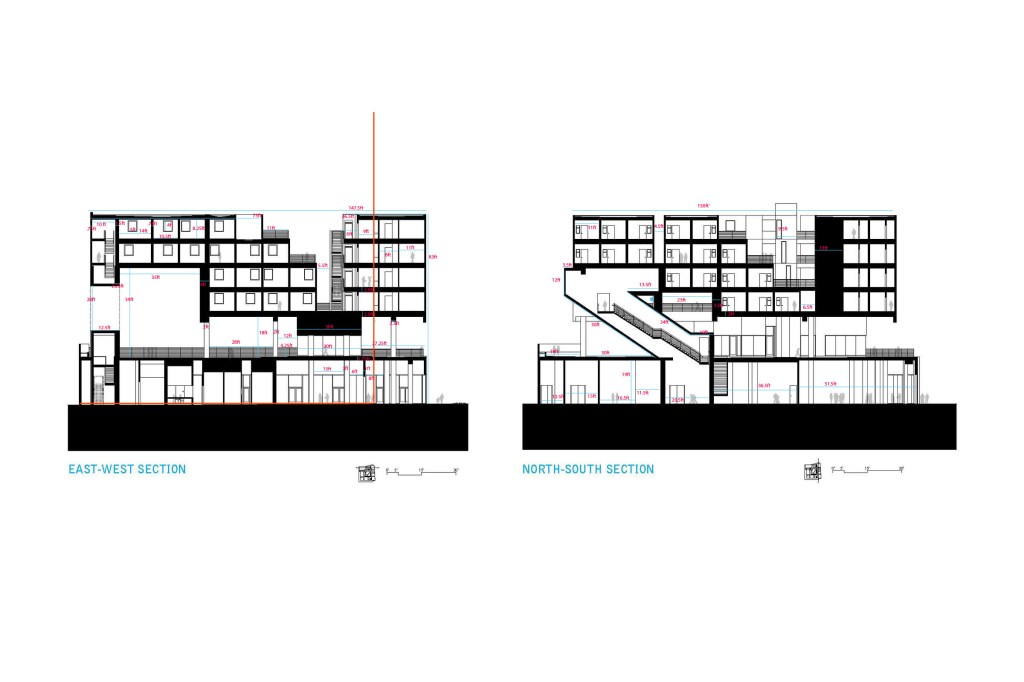
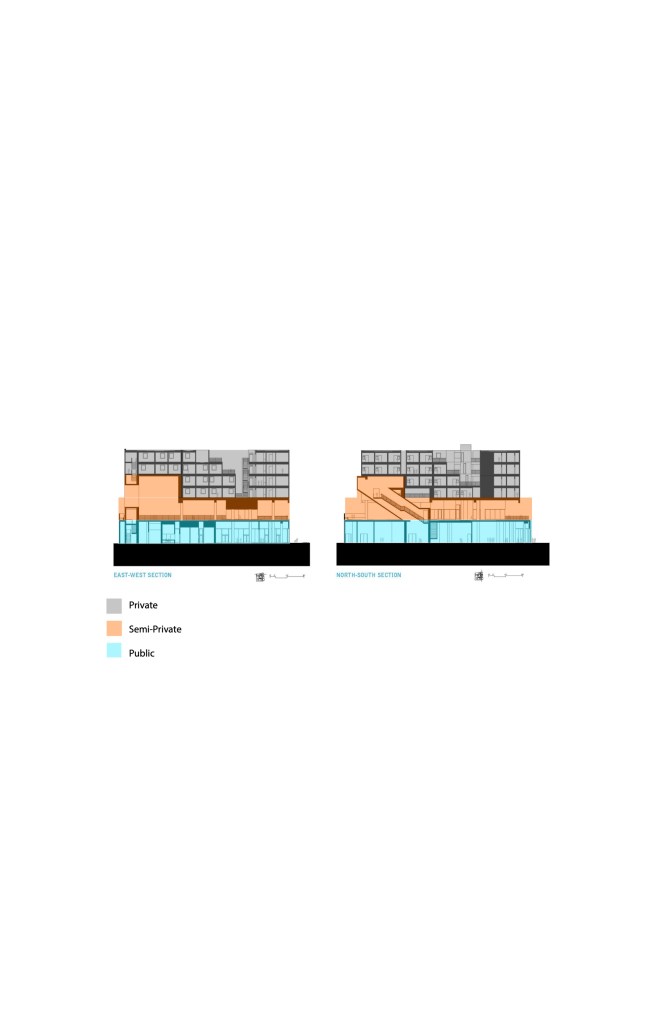
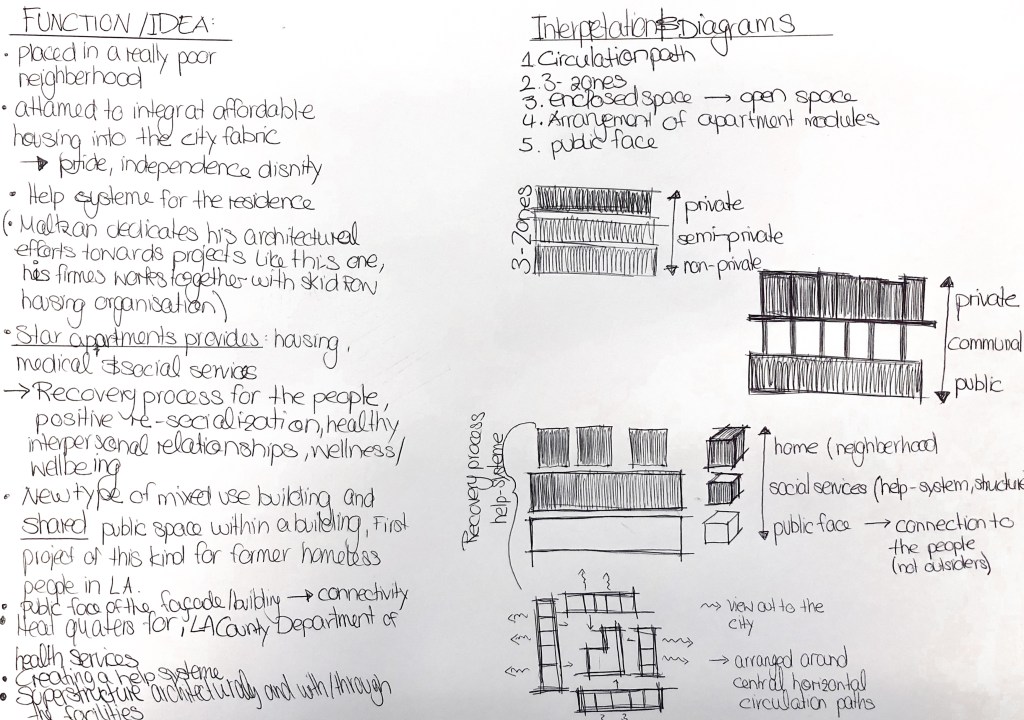
The six- story building was created through the development of three zones, layered on to top of each other. The first zone represents the public face of the building and is located at Street Level. It houses retail stores, a parking garage, the Health Clinic, the office of the Health county department and the main building entrance. The second zone is sits on top of the first floor and is designed as an open terrace featuring patios, a community garden, a jogging track, a basketball field as well as community programs such as a dinning and kitchen area, an arts room, a library, an exercise room and a community room. The third zone is placed on top of a concrete slab or tray that is supported by concrete columns rising up from the terrace. The tray is the base for the modular non-hierarchical placement of the apartment blocks. The interwoven apartment modules take up the four top floors of the building, representing the private zone of the project. The zones are connected through staircases that run vertical and that are partially integrated into the structural columns and through horizontal open-air corridors.
STRUCTURE
In order to provide enough support for the added-on structure, they needed to construct a concrete superstructure with post-tensioned slabs at the upper levels. Which means they combined conventional slab reinforcement materials with additional steel tendons. This procedure is supposed to help with reducing tension and it allows to achieve a much longer span width with thinner slabs. In addition to the concrete superstructure, they installed freestanding columns rising up from second floor. The exterior metal walkways are supported by steel framing.
PREFAB MODULES
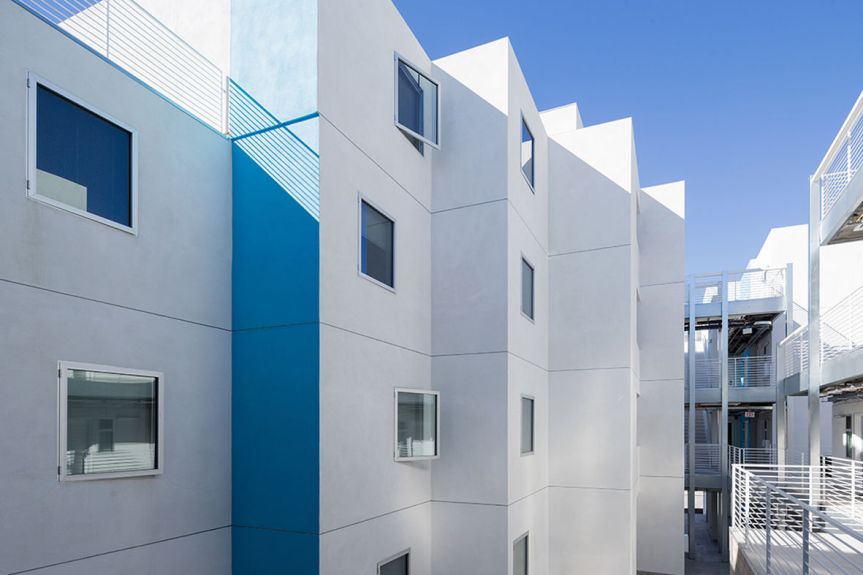
The last use of prefabrication for multiple- unit-housing in this scale was completed 50 years ago (by Dworsky Associates, project on Bunder-Hill). In order to employ prefab-units, they needed to go through a strict-testing to insure their safety. All the unites are uniform in size and layout. They were prefabricated by Guerdon Enterprise in Idaho. The units are self-supported and were shipped in pairs, held together by a connector that were sawn through, before the units craned into place and bolded together. A concrete tray and columns are supporting their weight. All wood boxes were fully equipped prior to installation. To disguise their factory-made character every box got a unique stucco finish.
The prefabrication building approach led to a reduction in construction costs, construction waste and improves the sustainability of the building.
PICTURES



PLANS AND ELEVATIONS



DIAGRAMS



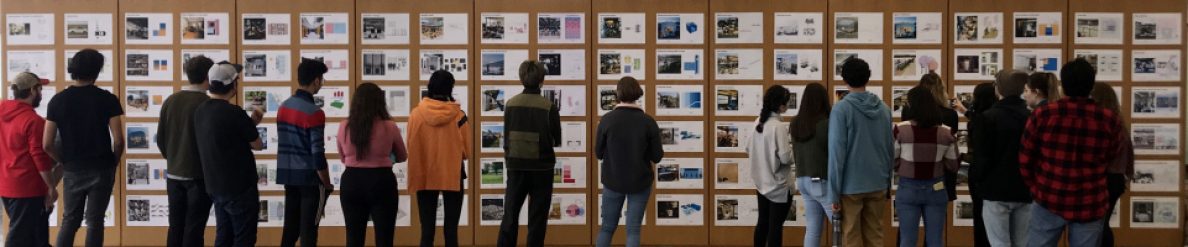
PRESENTATION
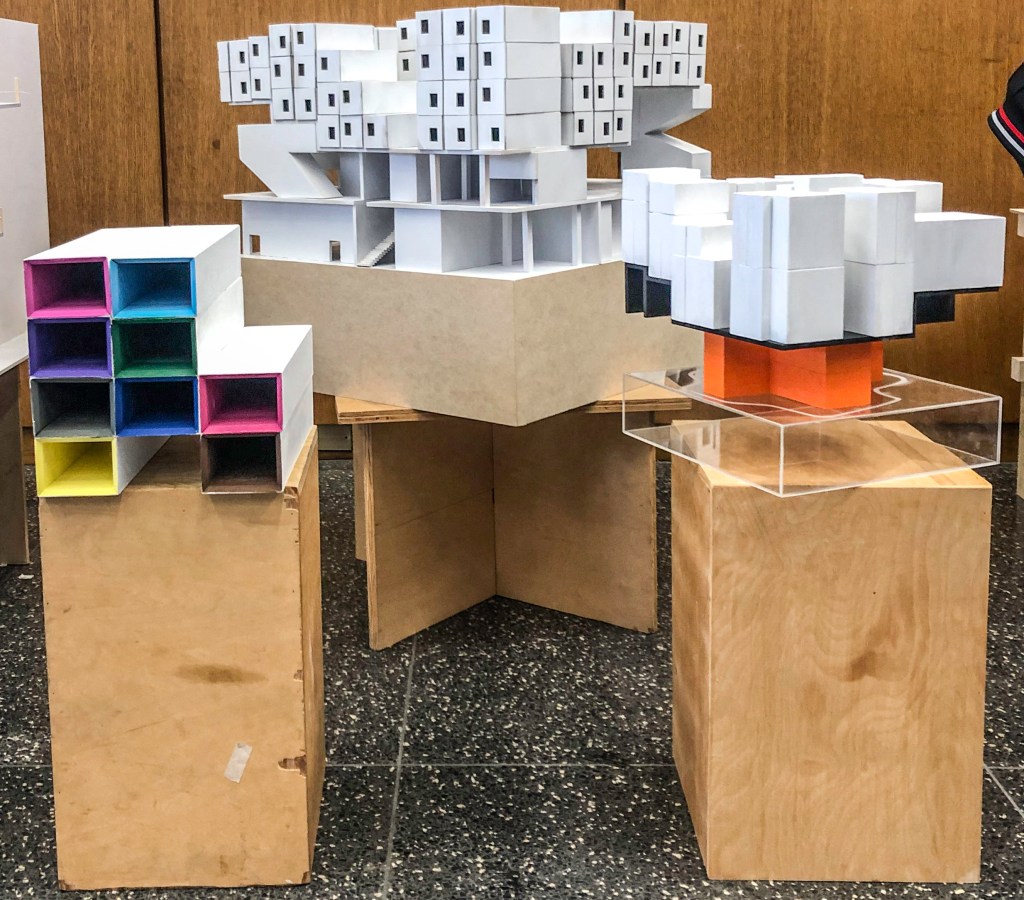
DETAIL MODEL SECTION CUT
The idea for the detail model was to possibly show all aspects of design that are significant to the overall design concept. We choose the scale and the section cut based on this idea. The way we sectioned through the building allowed us to show the retail space on the street floor, the community rooms, as well as the outdoor space and gardens on the second floor, the circulation paths, the structural columns and the modularity of the units on the top floors in greater detail.
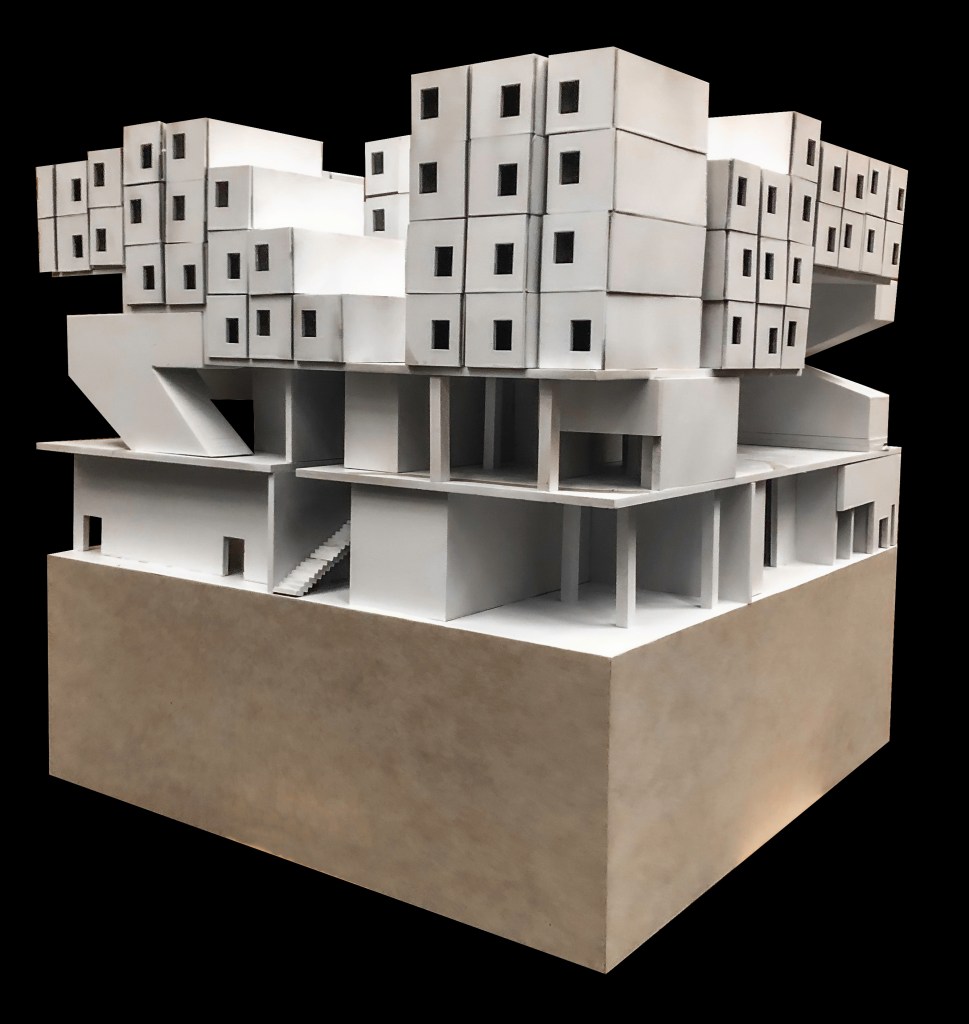

CONCEPT MODELS
For the concept models we chose to focus on two of the main aspects of the project.
3-ZONES
The first concept model was a representation of the three different zones that were layered on top of each other. We choose the materials according to their purpose. We create a base made out of clear acrylic in order to emphasize that it is representing the public face of the building and accessible for everyone. For the second floor we choose a bride color (in this case orange) to highlight the community programs, as they are indispensable for the project. To indicate the modularity of apartments and the emphasize on a non-hierarchical arrangement on the top floor, we cut out blocks of equal size and stuck them together according to the actual arrangement.
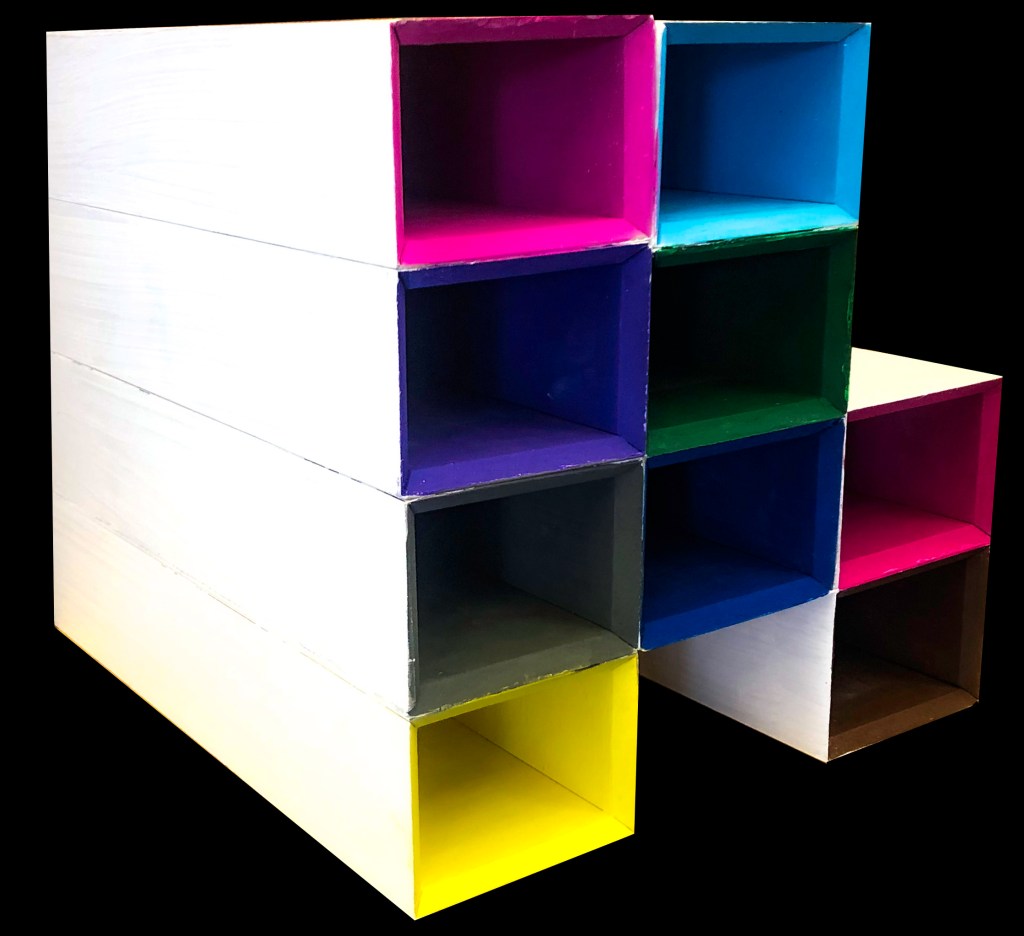

MODULES
With the second concept model we wanted to show that, although all apartments are prefabricated modular designs, they still have individual qualities to them. In order to convey the feeling of individuality, the architects choose a different stucco for the interiors of the unites. We indicated this by choosing different colors.

VOCABULARY
INTERSECTING:
(Vertical) paths of circulation (movement) are intersecting with the three zones of the building.
Horizontal corridors encourage conversation between the residence through intersection.
MERGE:
The overall project is a result of combining different programs
to a single entity. Communal, public and private interests
(ideas) are merged together in one development.
MIX:
Star Apartments is a mixed-use building. A variety of facilities and
programs are broth together at one place.
GATHER:
There are second floor gathering areas
Outdoor and indoor gathering spaces (shared spaces that the residence can use to pursuit to perform activities together).
LAMINATE:
The three zones are layered on top of each other.
BUNDLE:
Residential modules are a collection of entities.
CLOSING WORDS
Star Apartments represents a serious attempt to solving the problems arising with the housing crisis LA is currently facing. The architecture serves the needs of the residence and is a role model for future affordable housing developments. This project shows how shared and private space can coexist when employed in a certain architectural form.
ANALYSIS

Bibliography:
- “Star Apartments: Michael Maltzan Architecture.” Star Apartments | Michael Maltzan Architecture. Accessed January 17, 2020. https://www.mmaltzan.com/projects/star-apartments/.
- “Star Apartments: Michael Maltzan Architecture.” Archello. Accessed January 17, 2020.https://archello.com/project/star-apartments.
- Amelar, Sarah. “Star Apartments – Los Angeles.” Architectural Record RSS. Architectural Record, July 11, 2016. https://www.architecturalrecord.com/articles/7997-star-apartments-los-angeles.
- Ferro, Shaunacy. “Michael Maltzan’s Quest To Remake Housing For The Homeless.” Fast Company. Fast Company, July 25, 2018. https://www.fastcompany.com/3038425/michael-maltzans-quest-to-remake-housing-for-the-homeless.
John Coats
Anna Delseith
 Hathaway Section - Spring 2020
Anna and John,
Your the first project I’ve looked at that has a bibiliography as part of their post. Thank you for including. Looking at that and what you’ve written (both typed and your hand-written notes) I think you’re on to the significance of this project. I’d like you to push that a little further:
1. Can you give us a little more detail about Michael Maltzan and his overall practice: what types of projects does he do, what’s he known for? Who is he, where did he come from? How long has he been in independent practice? Be personal in your responses as well as factual: how do you respond to his projects? How would you describe his work?
2. Then, specifically address his relationship to affordable housing. How many projects, connection to the developer for this project…Also, does this project signify anything in the overall trajectory of his body of work or is it just affordable housing project number X of Y projects?
SITE AND CONTEXT
3. I’m not sure exactly what specifically might be interesting about the site and context but looking at the aerial photo, the site plan, and pulling it up on google maps, what else can you say about where the project is located, what road is it on, what are the buildings around it…? Is solar orientation important?
BUILDING
4. Will you color code the plans programmatically like you did the section (public/private/semi-private like the section works, but you should distinguish the other programs at the ground floor)? Also worth distinguishing in plan and section between the interior semi-private space and the exterior.
5. The “typical” upper floor plan doesn’t tell the whole story of the way the tray steps up in certain areas. Can you find floor plans of each level and correlate the sections with the plans and elevations as part of preparing for your detail model proposal?
6. Structure is important and I’m glad you got the exploded diagram of the building and talked about the “tray”. Can you trace that out as a diagram in section and elevation drawings? Also worth exploring and unfortunately not so clear in the overall diagram from Maltzan is the secondary steel structure of the stairs and walkways at the residential level- can you clarify?
7. Prefabrication. What is prefabricated? How does it work architecturally? structurally? (There used to be a time-lapse video of the construction that showed this, but also must be in articles and websites.)
FURTHER ASSESSMENT
8. Drawing on your notes and looking at the project, how does the second layer work? (Labeled semi-private in your section, although you could also label “shared”.) A lot of multi-unit buildings have some shared spaces for residents, a gym, a lounge… What does this building have, what form does it take, and how do you think that relates to the specific residents and the specific location of the project?
9. Sharing verbs: any of them stand out to you in the way this project works formally or programmatically? If that’s an area of struggle (you wouldn’t be alone in that) think about the unique aspects of the project, the second floor and the geometry of the tray above, or the way the residential is arranged and/or expressed architecturally.
LikeLike